Pattern Match Extension
Since NeuG v0.2.0, we have introduced the Pattern Match extension, which provides subgraph pattern matching over the current NeuG graph.
CALL PATTERN_MATCH(Pattern, size, is_sampled)
[YIELD ...]
RETURN *;Pattern— the graph pattern to match, e.g.'(a:Person)-[r:person_knows_person]->(b:Person)'. It uses Cypher node/relationship syntax. It is a pattern only, not a full query: every node and relationship must be written out explicitly, though an inlineWHEREis allowed (for node/relationship property filters).size(optional) — a positive integer (>= 1). In exact mode it is the early-termination bound (stop after the firstsizematches); in sampled mode it is the sample size.is_sampled(optional) — a boolean choosing the algorithm:false→ exact matching,true→ sampled matching (FaSTest). Must be written astrue/false(not0/1).
size and is_sampled go together. Omit both for plain exact matching over all matches:
CALL PATTERN_MATCH('(a:Person)-[r:person_knows_person]->(b:Person)') RETURN *;Supported Patterns
Supported:
- Directed relationships:
->and<- - One label per node, one type per relationship
- Multi-hop paths:
(a)-[r1]->(b)-[r2]->(c)(write each hop explicitly) - Cycles:
(a)-[r1]->(b)-[r2]->(c)-[r3]->(a) - Inline property maps with literal values:
(a:Person {age: 20}) - Inline
WHEREfor property-based filtering:(a:Person)-[r:knows]->(b:Person) WHERE a.age > 25
Examples:
-- Reverse direction
CALL PATTERN_MATCH('(a:Person)<-[r:person_knows_person]-(b:Person)') RETURN *;

-- Inline property map (only match Person nodes with age = 20)
CALL PATTERN_MATCH('(a:Person {age: 20})-[r:person_knows_person]->(b:Person)') RETURN *;

-- Inline WHERE (only match edges where source age > 25)
CALL PATTERN_MATCH('(a:Person)-[r:person_knows_person]->(b:Person) WHERE a.age > 25') RETURN *;

-- Multi-hop path (2 hops)
CALL PATTERN_MATCH('(a:Person)-[r1:person_knows_person]->(b:Person)-[r2:person_knows_person]->(c:Person)') RETURN *;

-- Triangle cycle (3 hops back to start)
CALL PATTERN_MATCH('(a:Person)-[r1:person_knows_person]->(b:Person)-[r2:person_knows_person]->(c:Person)-[r3:person_knows_person]->(a:Person)') RETURN *;
Not supported (rejected at bind time):
- Variable-length / recursive relationships:
-[:R*3]->,-[:R*1..3]->,-[*]-> - Undirected relationships:
(a)-[r]-(b) - Multi-label nodes:
(a:A:B) - Multi-type relationships:
[:A|:B] OPTIONAL MATCH,WITH,UNION, mutationsOR,NOT,XORinWHERE- Cross-variable comparisons:
a.age = b.age - Computed projections,
ORDER BY,SKIP,LIMITinside the pattern
Write a fixed-length path out one relationship at a time instead of using *.
Install Extension
INSTALL pattern_matching;Load Extension
LOAD pattern_matching;When building from source, enable the extension with:
cmake -S . -B build -DBUILD_EXTENSIONS="pattern_matching" -DBUILD_TEST=ON
cmake --build build --target neug_pattern_matching_extension -j$(sysctl -n hw.ncpu)
On Linux, use -j$(nproc) instead of -j$(sysctl -n hw.ncpu).
Exact Matching
Call PATTERN_MATCH with only the pattern to enumerate all exact embeddings:
CALL PATTERN_MATCH('(a:Person)-[r:person_knows_person]->(b:Person)')
RETURN *;
Output shape — one row per match, vertices as Vertex columns and relationships as Edge columns, named by the pattern aliases:
| a | r | b |
|---|---|---|
Vertex(Person) | Edge(person_knows_person) | Vertex(Person) |
For multi-hop patterns, each hop produces its own column:
| a | r1 | b | r2 | c |
|---|---|---|---|---|
Vertex(Person) | Edge(person_knows_person) | Vertex(Person) | Edge(person_knows_person) | Vertex(Person) |
To stop after the first size matches (early termination), pass size with is_sampled = false:
-- exact matching, stop after the first 10 matches
CALL PATTERN_MATCH('(a:Person)-[r:person_knows_person]->(b:Person)', 10, false)
RETURN *;
Sampled Matching
Pass size with is_sampled = true when exact enumeration may be too expensive and sampled embeddings are sufficient:
CALL PATTERN_MATCH(
  '(a:Person)-[r:person_knows_person]->(b:Person)',
  1000, true
)
RETURN *;
Here size is the target sample size. The function returns sampled embeddings using the same vertex/edge column layout as the exact mode.
The sampled implementation is based on the FaSTest filtering-sampling algorithm described in “Cardinality Estimation of Subgraph Matching: A Filtering-Sampling Approach” (VLDB 2024). The implementation computes FaSTest estimates internally, but the public table function returns sampled matches as native QueryResult rows rather than estimated_count, result_file, or props_file columns.
Applying NeuG Operators to the Result
Because the output vertex/edge variables carry the same catalog and property metadata as a MATCH-bound node, NeuG’s own pipeline clauses can be applied on the trailing RETURN: property access, ORDER BY <var>.<prop>, LIMIT, and aggregates such as count(<var>) and count(DISTINCT <var>.<prop>).
-- project scalar properties, order and limit
CALL PATTERN_MATCH('(a:Person)-[r:person_knows_person]->(b:Person)')
RETURN a.name AS src, r.weight AS weight
ORDER BY r.weight DESC
LIMIT 10;

-- aggregate over the matches
CALL PATTERN_MATCH('(a:Person)-[r:person_knows_person]->(b:Person)')
RETURN count(a) AS matches, count(DISTINCT a.name) AS distinct_sources;
YIELD
PATTERN_MATCH supports an optional YIELD clause between the call and the trailing RETURN. YIELD lists the pattern variables to expose to the rest of the query and may rename them with AS:
-- expose all matched variables (equivalent to omitting YIELD)
CALL PATTERN_MATCH('(a:Person)-[r:person_knows_person]->(b:Person)')
YIELD a, r, b
RETURN a.name, r.weight, b.name;

-- rename matched variables
CALL PATTERN_MATCH('(a:Person)-[r:person_knows_person]->(b:Person)')
YIELD a AS src, b AS dst
RETURN src.name, dst.name;

-- expose only a subset; unlisted variables are hidden from RETURN
CALL PATTERN_MATCH('(a:Person)-[r:person_knows_person]->(b:Person)')
YIELD b
RETURN b.name;
Rules and limitations, consistent with the rest of NeuG’s YIELD:
- A
YIELDitem is a bare variable name, optionally followed byAS <alias>. It refers to a whole pattern variable (aVertexorEdge). YIELDcannot contain a property access.YIELD a.nameis a syntax error; access properties in the trailingRETURN(e.g.YIELD a RETURN a.name).- A variable that is not listed in
YIELDis hidden — referencing it inRETURNraises a “not in scope” error. - Yielding a name that is not a pattern variable raises a bind error.
YIELDmust be followed by aRETURN; it does not terminate the query on its own.
Ordering by a whole Vertex/Edge object (for example ORDER BY a) is not supported by NeuG; order by a scalar property such as ORDER BY a.age instead.
End-to-end Example
A complete, runnable sequence — create the schema, insert a small graph, load the extension, then match. Every statement can be run as-is in the CLI or via conn.execute(...):
-- 1. Schema
CREATE NODE TABLE Person(id INT32 PRIMARY KEY, name STRING, age INT32);
CREATE REL TABLE person_knows_person(FROM Person TO Person, weight DOUBLE);

-- 2. Data (3 people, a directed triangle of "knows" edges)
CREATE (n:Person {id: 0, name: 'Alice', age: 20});
CREATE (n:Person {id: 1, name: 'Bob',   age: 30});
CREATE (n:Person {id: 2, name: 'Carol', age: 40});
MATCH (a:Person), (b:Person) WHERE a.id = 0 AND b.id = 1
CREATE (a)-[:person_knows_person {weight: 0.5}]->(b);
MATCH (a:Person), (b:Person) WHERE a.id = 1 AND b.id = 2
CREATE (a)-[:person_knows_person {weight: 1.5}]->(b);
MATCH (a:Person), (b:Person) WHERE a.id = 2 AND b.id = 0
CREATE (a)-[:person_knows_person {weight: 0.5}]->(b);

-- 3. Load the extension
LOAD pattern_matching;

-- 4. Exact match: all (a)-[r]->(b) embeddings
CALL PATTERN_MATCH('(a:Person)-[r:person_knows_person]->(b:Person)') RETURN *;

-- 5. Project / order / limit on the matched output
CALL PATTERN_MATCH('(a:Person)-[r:person_knows_person]->(b:Person)')
RETURN a.name AS src, b.name AS dst, r.weight AS weight
ORDER BY weight DESC LIMIT 5;

-- 6. Aggregate over the matches
CALL PATTERN_MATCH('(a:Person)-[r:person_knows_person]->(b:Person)')
RETURN count(a) AS matches, count(DISTINCT a.name) AS distinct_sources;

-- 7. YIELD: rename and expose only the columns you need
CALL PATTERN_MATCH('(a:Person)-[r:person_knows_person]->(b:Person)')
YIELD a AS src, b AS dst
RETURN src.name AS source, dst.name AS destination
ORDER BY source;

-- 8. Sampled matching (sample size 2)
CALL PATTERN_MATCH('(a:Person)-[r:person_knows_person]->(b:Person)', 2, true) RETURN *;
The same flow as a runnable Python script (using the in-repo bindings) is available at tools/python_bind/example/pattern_match_demo.py:
python3 tools/python_bind/example/pattern_match_demo.pyUsing the Locally Built Extension
The build above produces build/extension/pattern_matching/libpattern_matching.neug_extension. LOAD pattern_matching; resolves to <home>/extension/pattern_matching/libpattern_matching.neug_extension, where <home> comes from the NEUG_EXTENSION_HOME_PYENV environment variable.
When you use the in-repo Python bindings this is automatic: importing neug discovers neug_py_bind under the build tree and sets NEUG_EXTENSION_HOME_PYENV to <repo>/build for you, so LOAD pattern_matching; picks up the freshly built library with no extra setup:
import neug
from neug.database import Database

db = Database("/tmp/demo_db", "w")
conn = db.connect()
conn.execute("LOAD pattern_matching;")  # loads build/extension/pattern_matching/...
If your build tree lives elsewhere, point the loader at it before importing neug:
# directory containing tools/python_bind/neug_py_bind* and extension/
export NEUG_BUILD_DIR=/path/to/neug/build
# or set the extension home directly (the dir that contains extension/):
export NEUG_EXTENSION_HOME_PYENV=/path/to/neug/build
Experiments
We benchmarked three ways of running the same subgraph-matching patterns on the LDBC SNB scale-factor 1 (SF1) dataset:
- NeuG-Native — NeuG’s built-in Cypher engine (
MATCH ... RETURN ...); - Exact-Match —
CALL PATTERN_MATCH(pattern)(exact enumeration of all embeddings); - Sample-Match —
CALL PATTERN_MATCH(pattern, 1000000, true)(sampled matching, sample size 1,000,000).
The six test patterns (Q1–Q6) are adapted from the LDBC LSQB query set. Each query runs with a 10-minute timeout; a run that exceeds it is marked OOT (out of time).
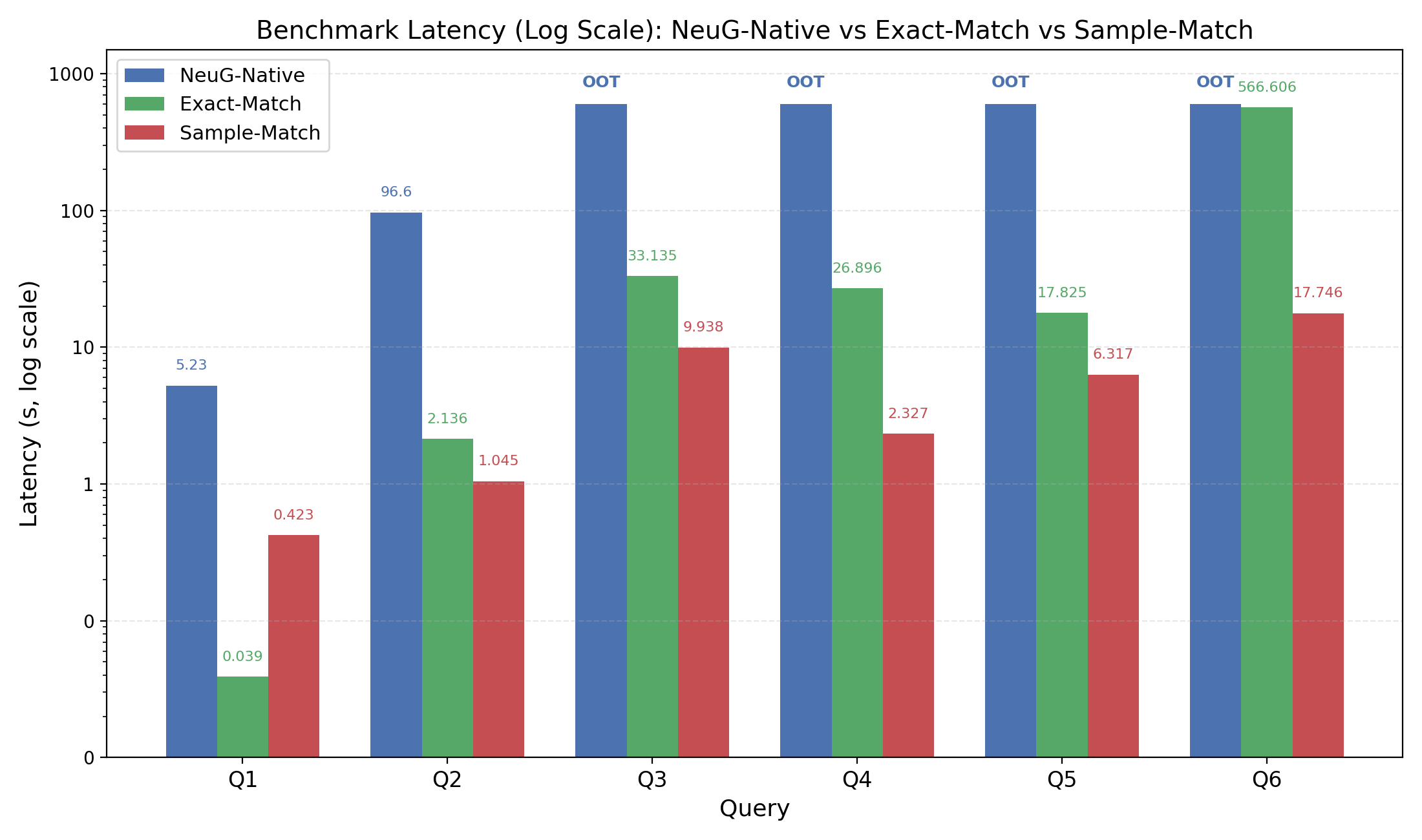
The figure reports end-to-end latency in seconds (log scale). Key observations:
- NeuG-Native handles the small patterns (Q1, Q2) but times out (OOT) on the larger ones (Q3–Q6), whose full result sets are enormous (tens of millions to billions of embeddings).
- Exact-Match completes every query within the timeout and is one to several orders of magnitude faster than the native engine on the large patterns.
- Sample-Match keeps latency low and stable across all six patterns and is the fastest option on the larger, high-cardinality patterns (Q2–Q6).
References
The matching algorithms in this extension draw on the methods and ideas of the following works from the SNU CSE Theory & Algorithms group, which we gratefully acknowledge:
- FaSTest — Cardinality Estimation of Subgraph Matching: A Filtering-Sampling Approach (VLDB 2024). The sampled matching mode is based on FaSTest. https://github.com/SNUCSE-CTA/FaSTest
- DAF — Efficient Subgraph Matching: Harmonizing Dynamic Programming, Adaptive Matching Order, and Failing Set Together (SIGMOD 2019). The exact matching design was informed by DAF’s approach. https://github.com/SNUCSE-CTA/DAF